A builder's website has one advantage most businesses would pay a fortune for: a steady supply of real, local, visual proof of work. Every completed project is a story with a suburb name, photos, a challenge and an outcome. Most builders leave that material in a phone gallery or a Facebook album. The ones who turn it into indexed pages tend to rank, because Google rewards exactly the kind of specific, first-hand content that builders generate as a by-product of doing their job.
This guide covers SEO for builders in practical terms: what a homeowner's search looks like, how to structure a builder's website so it can rank, why project pages matter more than anything else, how to compete without a display home, and the local signals that put you in the map pack.
In this article
- › How homeowners search for builders
- › Site structure for a builder's website
- › Project pages: the core of builder SEO
- › Competing without a display home
- › Service pages by project type
- › Local signals: Google Business Profile, reviews and suburbs
- › Trust content that ranks and converts
- › Technical basics builders get wrong
- › A 12-month SEO plan for a builder
How homeowners search for builders
Homeowners rarely search "builder". They search for a project type in a place: "extension builder Camberwell", "knockdown rebuild Northern Beaches", "custom home builder Sunshine Coast", "renovation builder near me". Further back in their research, they search questions: "how much does a second storey extension cost", "do I need a builder or an architect first", "what does a builder's contract include".
Those two search types need two kinds of content. Project-type-plus-location searches need service and suburb pages backed by project evidence. Question searches need articles and cost guides. A builder's website that ranks has both, linked together so someone who lands on a cost guide can move to the relevant service page and then to a comparable project.
Site structure for a builder's website
The structure that ranks is simple and most builder websites don't have it:
- Home: who you are, what you build, where, and the strongest project imagery.
- One service page per project type: new homes, knockdown-rebuild, extensions, renovations, dual occupancy, whatever you actually do.
- One location page per area you target: the suburbs or regions where you want work, each with genuine local detail.
- One page per significant project: the evidence layer, linked from the relevant service and location pages.
- Trust pages: about, team, registration and insurance, process, reviews.
- Guides and articles: cost guides and answers to the questions homeowners ask.
A single "our services" page listing everything can't rank for any of it. A gallery slider of forty photos with no text is invisible to Google. Splitting content into dedicated pages is the single biggest structural change most builder websites need.
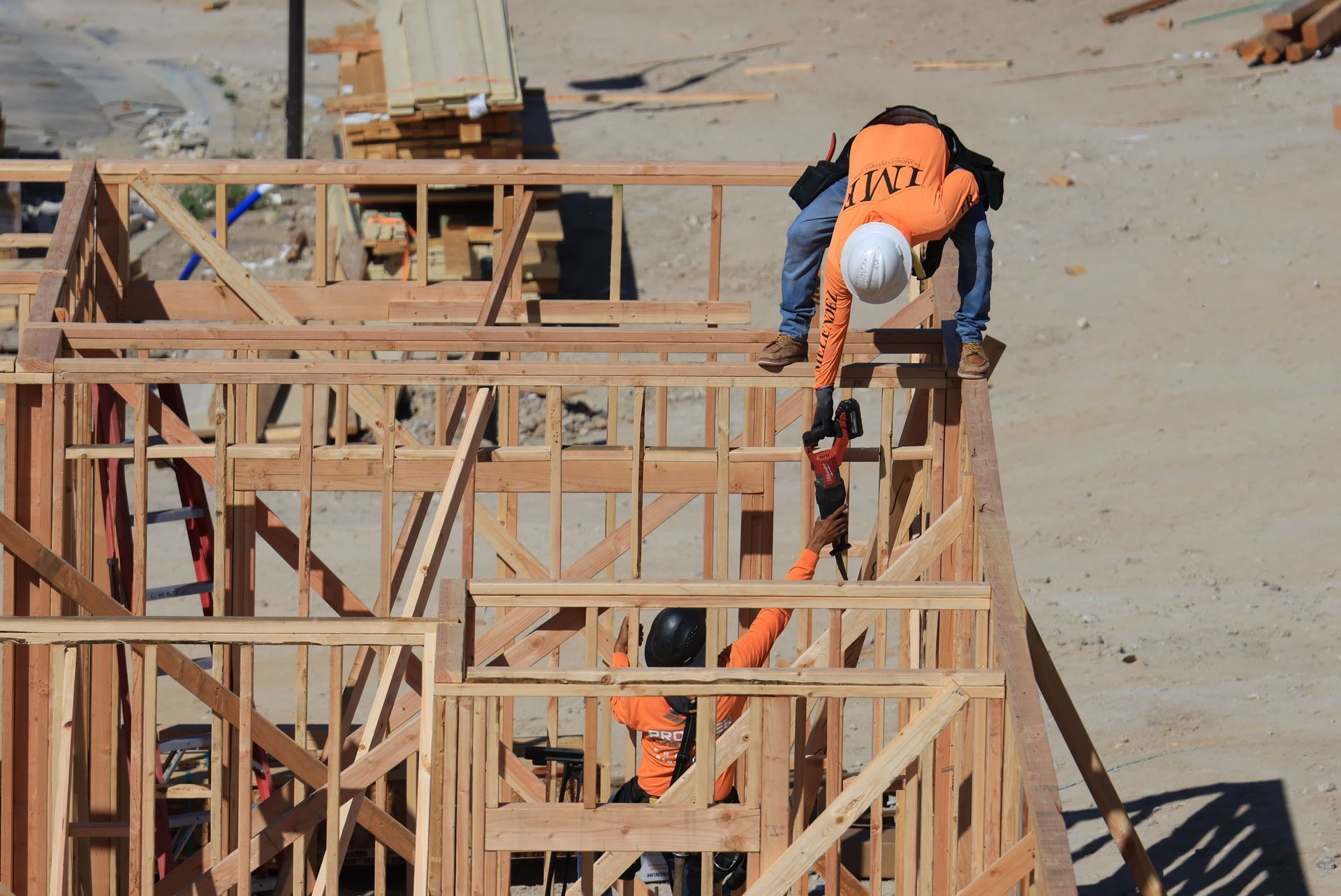
Project pages: the core of builder SEO
For a builder, project pages do more ranking work than any other content type. Each one targets a location-plus-project-type search, adds authority to the service pages it links to, and gives a homeowner the proof they came looking for. A project page that ranks includes:
- A descriptive title. "Second storey extension, Bentleigh East" rather than "Project 14".
- The suburb and the brief. What the client wanted and why.
- The challenge. Sloping site, heritage overlay, tight access, living in during the build. Real detail.
- What you did. Scope, key decisions, materials, timeframe.
- The outcome. Delivered on time, what changed for the family, and a short client comment if you have one.
- Photos with descriptive alt text. Before, during and after. Compressed for speed.
- Links to the service page for that project type and the location page for that suburb.
Ten project pages written this way will do more for a builder's rankings than a hundred gallery images and a monthly blog about industry news. Our content team writes them with builders because the detail has to be right.
Competing without a display home
Volume builders have display villages, national brands and budgets a custom builder can't match. Competing with them for "new home builder Brisbane" is a losing game. Custom, renovation and mid-tier builders win by going where volume builders don't:
- Project types volume builders avoid. Knockdown-rebuild on difficult blocks, extensions, heritage renovation, sloping sites, dual occupancy, acreage.
- Established suburbs rather than new estates. Where display homes don't reach and buyers are actively avoiding volume builders.
- Depth over breadth. Six detailed project pages for one suburb beat one page claiming to service the whole city.
- Your project pages as the display home. Photos, floor plans where you can share them, and video walk-throughs let a homeowner "visit" your work online.
The searches in these gaps are lower volume but far higher intent, and the competition is often other small builders with weak websites.
Service pages by project type
Each service page should be written for the homeowner considering that project, not for other builders. It covers what the project involves, typical timeframes, what affects cost (with a realistic range if you're prepared to publish one), how your process works, what approvals are typically needed, and three or four linked project examples. A page for extensions in Melbourne's inner east that mentions heritage overlays, council requirements and living-in-during-the-build logistics will rank and convert. A page that says "we do quality extensions" will do neither.
Local signals: Google Business Profile, reviews and suburbs
For "builder near me" and "builder Dubbo" searches, the map pack is where the clicks go. Your Google Business Profile drives it:
- Primary category set to the most specific option that fits (home builder, general contractor, remodeler) rather than "construction company".
- Service area matched to the suburbs you actually want work in.
- Services listed individually, mirroring your service pages.
- Photos of real projects, uploaded regularly.
- Reviews collected at every handover, with responses. Reviews that mention the suburb and project type ("our extension in Coorparoo") reinforce local relevance.
Consistent business name, address and phone across directories, industry bodies and social profiles supports the profile. Our Google Business Profile guide covers the full set-up.
Trust content that ranks and converts
Homeowners check registration and insurance before they call, and they search for it. A page that plainly explains your builder registration or licence (QBCC, VBA, NSW Fair Trading or the WA Building and Energy register depending on your state), your insurances, your contract type and how progress payments work, ranks for the checking searches and removes a reason to hesitate. Named team profiles with credentials and a clear process page ("what happens from first call to handover") do the same job. This content is rarely written by builders, which is exactly why it works.
Technical basics builders get wrong
Builder websites are image-heavy, and that creates predictable technical problems:
- Uncompressed photos. Full-resolution project images are the most common cause of slow builder websites. Compress everything and use modern formats.
- Gallery sliders with no text. Google can't rank what it can't read. Every image needs alt text and, ideally, a project page around it.
- PDFs behind forms. Brochures and floor plans locked behind a form don't get indexed.
- Mobile rendering. Most homeowner searches happen on a phone. Test every page.
- Redesigns without redirects. Changing URLs when you rebuild the site without redirecting the old ones throws away rankings. Our web design and conversion FAQs cover how to avoid it.
A 12-month SEO plan for a builder
- Months 1 to 2: Technical fixes and compression. Google Business Profile rebuilt. Service pages written for each project type. Registration and process pages published.
- Months 2 to 4: First six project pages. Location pages for two or three target suburbs. Review request process running.
- Months 4 to 8: One new project page a month. First cost guides and question articles. Location pages expanded as rankings arrive.
- Months 8 to 12: Continue project pages. Add video walk-throughs. Review rankings for project-type-plus-suburb terms and fill gaps.
By month twelve a builder following this plan typically ranks on page one for project-type-plus-suburb terms across their target areas, appears in the map pack for their core suburbs, and has organic search as a consistent source of qualified enquiry. Our guide to how long SEO takes for a construction business sets out the milestones in more detail, and our guide to how builders generate leads online puts SEO alongside the other channels.
Constructiv Digital provides SEO for builders across Australia, with project-page-led content and the technical set-up that lets image-heavy sites rank. If you'd like to know where your website stands and what it would take to rank in your area, get in touch with our team.